

In-House vs Offshore Software Development
You face pressure on speed, quality and cost. You also face a choice. You pick In-house vs outsourcing software development based on control, capability and runway. This guide gives you a clear way to compare both paths. You get a decision checklist and a cost-quality-speed scorecard. You also see how an offshore software development company in India fits into your plan.
- What in-house means for you
- What offshore means for you
- Offshore software development benefits you measure
- Advantages of offshore software development in India
- Head-to-head: In-house vs outsourcing software development
- When you choose In-house
- When you choose offshore
- Hybrid model that many enterprises adopt
- ROI example you can adapt
- How you decide in one week
- FAQs in plain words
- Ready to move from debate to delivery
What in-house means for you
You hire full time engineers. You shape culture and process. You keep knowledge inside your walls. You accept higher fixed costs and longer ramp ups.
Strengths
- Deep domain context lives with your team
- Direct control over architecture and security
- Stable velocity once the team settles
Tradeoffs
- Hiring cycles add months before shipping
- Total cost of ownership grows with benefits and tooling
- Capacity spikes are hard during peak quarters
Teams that go In-house often do so for core products. You get strong alignment and you tune quality day by day. You also accept the cost of management effort and attrition risk.
What offshore means for you
You engage an external partner. You scale fast using ready squads. You turn some fixed cost into variable cost. You keep product direction while your partner executes.
Strengths
- Access to specialized skills on demand
- Faster team formation for new workstreams
- Flexible budgets across quarters
Tradeoffs
- Added effort for communication and governance
- Risk of misaligned expectations without a clear SoW
- Vendor selection takes due diligence
An offshore software development firm brings delivery muscle. You still own the roadmap. You set outcomes and guardrails. You also adopt a playbook for collaboration and quality.
Offshore software development benefits you measure
You want real numbers. Use a simple scorecard across cost, quality and speed. Assign 1 to 5 for each axis then compare totals.
- Cost: Many enterprises observe 20-40% savings in run rate when they right size teams and reduce vacancy lag. You also avoid recruitment overheads that often add 15-25% to first year cost.
- Quality: Mature partners show automated tests, CI pipelines and coding standards. You inspect release defect rates and aim for steady decline across sprints.
- Speed: Stand up a two-pizza squad in weeks rather than months. You shorten time to first release when a partner brings ready accelerators.
You should validate these numbers in your context. Run a 6-8 week pilot and capture baseline metrics.
Advantages of offshore software development in India
An offshore software development company in India gives you reach and scale. You get strong STEM talent and proven delivery practices. You also get time zone coverage that supports follow the sun work.
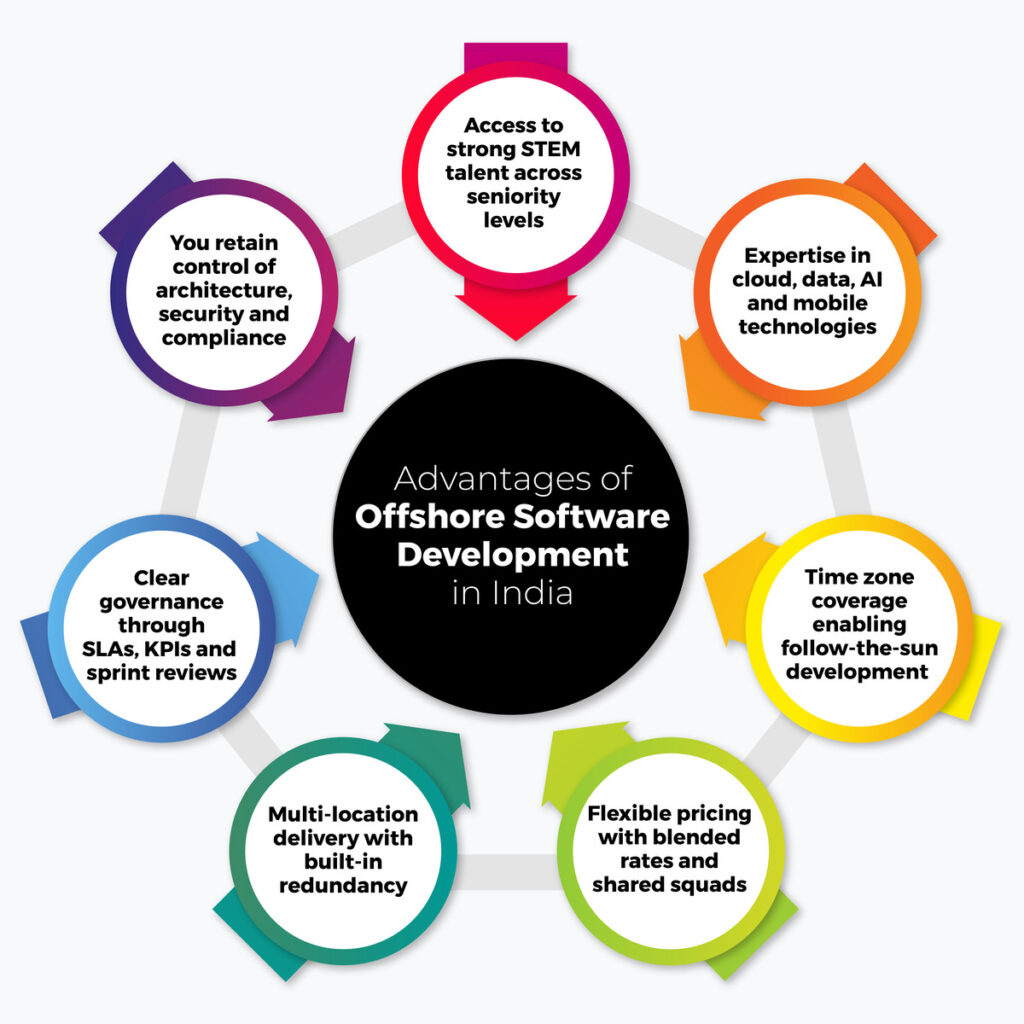
- Talent depth: India produces large numbers of engineering graduates each year. You tap cloud, data, AI and mobile skills across seniority bands.
- Cost control: Rate cards vary by city and skill. You structure blended rates and shared squads to match your budget.
- Continuity: Mature vendors offer redundancy across locations. You protect delivery from local outages.
- Governance: You set SLAs and engineering KPIs. You review burnup charts and quality gates every sprint.
You still own architecture and security. You define guardrails and verify compliance.
Head-to-head: In-house vs outsourcing software development
Use this side-by-side view to anchor your call.
- Control and culture
You get the highest control in the house. You shape rituals and career paths. You may move slower at the start. Outsourcing gives you speed and outside perspective. You set standards then inspect outcomes. - Cost profile
In-house adds salary, benefits and tooling. Vacancy gaps also slow delivery. Outsourcing converts part of this to variable spend. You scale squads up or down as priorities change. - Risk and resilience
In-house concentrates risk in one location. Absence or attrition hits timelines. Offshore spreads work across pods. You draft backup plans and cross train members. - Security and IP
In-house feels safer by default. You still follow strict controls. Offshore follows the same controls when you enforce them. You use VPC access, SSO, code reviews and audit trails. - Innovation
In-house knows your domain best. Offshore brings patterns from many clients and stacks. You blend both to avoid tunnel vision.
When you choose In-house
Choose In-house when the code is your secret sauce. Your platform defines competitive advantage. You need tight loops with product and design. You also have time and budget to hire and nurture talent.
Signals that favor In-house:
- Core algorithms or IP heavy modules
- Long horizon product bets
- High compliance needs in regulated sectors
When you choose offshore
Choose offshore when speed to market matters. You need skills you do not have today. You want elastic capacity across quarters. You also want delivery at a predictable cost.
Signals that favor offshore:
- New modules or greenfield apps
- Modernization of legacy systems
- Data engineering and AI experiments
- DevOps consulting, QA automation and platform engineering
You still appoint a strong product owner. You set the backlog and define Done. You also keep code reviews inside your architecture group.
Hybrid model that many enterprises adopt
Most enterprises combine both. You keep a small core In-house for product strategy and critical modules. You partner with an offshore software development firm for execution scale. You get the best of both when you follow a clear operating model.
Operating model checklist
- Clear scope of work and acceptance criteria
- Product owner and tech lead on your side
- Shared Definition of Done and coding standards
- Trunk based development and CI pipelines
- Sprint reviews with working software
- Joint security and compliance reviews
This model lets you protect IP while you scale velocity. You also reduce hiring risk in volatile markets.
ROI example you can adapt
Assume you need a 10 person squad for one year. You compare options at a high level. Numbers vary by role mix and city. Use them as a template.
- In-house: Salary plus benefits plus overhead often lands at a higher annual run rate. Time to hire adds months before full velocity
- Offshore hybrid: A blended squad from an offshore software development company in India reduces run rate. Start time is shorter. You also pay for delivered outcomes when you use milestone based pricing
Run your own model with real rates and timelines. Add risk buffers and onboarding costs on both sides. Pick the path that gives you faster learning cycles.
How you decide in one week
You do not need a long study. Use this one week plan.
- Day 1–2
Define business goals and quality targets. Rank the modules by risk and value. Mark what must stay In-house. - Day 3–4
Shortlist two vendors for offshore software development India. Request a solution outline and a small spike plan. - Day 5
Run a technical deep dive. Review architecture, security and delivery playbook. Align on KPIs and reporting. - Day 6–7
Pick a pilot. Draft a 6-8 week SoW. Set exit criteria and success metrics.
You move from debate to data in two sprints.
FAQs in plain words
- Is In-house always better for quality
Quality depends on culture and process. You get great results when you enforce standards and measure outcomes. - Will offshore hurt speed
Speed improves when you start fast and keep tight feedback loops. Clarity and ownership beat proximity. - How do you protect IP offshore
Work inside your cloud. Grant least privilege access. Sign strong contracts. Review code inside your repos.
Ready to move from debate to delivery
You now have a clear view of In-house vs outsourcing software development. You also saw offshore software development benefits and the advantages of offshore software development in a hybrid model. If you want a partner that aligns to your product goals, talk to BuzzyBrains Software. We are an offshore software development company in India. You get senior engineers, strong engineering practices and predictable delivery.
Start your pilot today.