

MLOps for Agentic AI: Best Practices Guide
You now work in a world where AI systems act, learn and adapt without human intervention. You see autonomous agents completing tasks, retrieving information, writing code, optimizing workflows and making decisions. You want these systems to work reliably in production. You want them to scale without breaking your pipelines. This is where MLOps become essential. You create predictable and stable environments when you manage agentic AI through strong operational processes.
Your role as a CTO or tech leader puts you at the center of this shift. Your teams now handle models that update themselves. Your systems interact with external tools, APIs and knowledge bases. Your workflows depend on consistent performance across dynamic scenarios. You want to protect uptime, reduce errors and prevent failures. You also want fast iteration and safe deployment. MLOps helps you achieve this balance.
- The Rise of Agentic AI in Modern Businesses
- Why Agentic AI Needs Strong MLOps Foundations
- Understanding Agentic AI Architecture
- Best Practices for Applying MLOps to Agentic AI
- MLOps Blueprint for Operationalizing Agentic AI
- Challenges You Face When Scaling Agentic AI
- Industry Use Cases of Agentic AI with MLOps
- Future Outlook for Agentic AI and MLOps
- Key Takeaways
- Empower Your Autonomous AI Strategy with BuzzyBrains Software
The Rise of Agentic AI in Modern Businesses
You observe a surge in autonomous AI use cases. These include research assistants, financial agents, supply chain agents, support bots, automation orchestrators and personalized recommendation engines. You also see engineering teams using agents for code refactoring, documentation generation and data pipeline monitoring.
Businesses show strong interest in agentic systems because these agents reduce manual effort. Gartner predicts that over 40 percent of large enterprises will deploy agentic AI in production by 2026 . You also see high investment in organizations that explore complex multi-step automation using AI agents.
This shift increases demand for reliable operational processes. You cannot rely on ad-hoc workflows. You need structure. You need versioning, observability, governance and continuous experimentation. You solve this through MLOps consulting services that help you operationalize agents safely.
Why Agentic AI Needs Strong MLOps Foundations
You deal with dynamic models, unpredictable interactions and rapid iteration cycles. Traditional ML pipelines do not handle these complexities. You require systems that support:
- Continuous model updates
- Automated evaluation
- Monitoring of agent decisions
- Secure tool access
- Scalable inference
- Human oversight mechanisms
Agent behavior changes as it learns from new data. You need monitoring that tracks unpredictability. You also need automated tests that evaluate logical reasoning, task completion quality, tool interactions and safety constraints. Your team prevents risks when you use the right tools and workflows from an MLOps consulting services company.
Understanding Agentic AI Architecture
Agentic AI relies on several components working together. You improve operational reliability when you understand how these components interact.
1. Foundation Model
Large models such as LLMs or multimodal models power reasoning, planning and understanding. These models serve as the brain of the agent.
2. Memory Systems
You store short-term task memory and long-term knowledge. This helps your agent recover context and refine decisions.
3. Tool Use
You integrate external APIs, databases or execution engines. Your agent performs actions based on goals.
4. Planning and Decision Layer
You structure multi-step logic. This defines how your agent breaks a problem into smaller tasks.
5. Feedback and Self-Improvement
You allow agents to evaluate outputs and correct themselves. This increases accuracy.
Your MLOps strategy ensures these components run reliably in production and scale efficiently.
Best Practices for Applying MLOps to Agentic AI
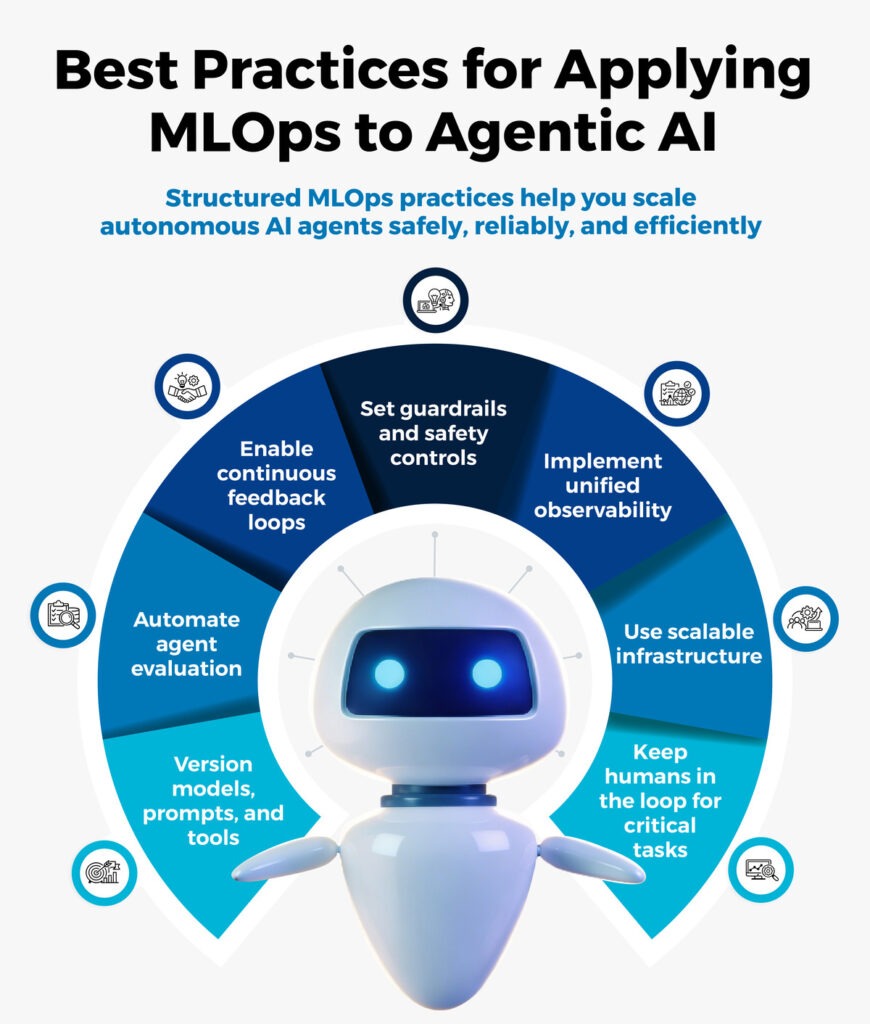
1. Build Clear Versioning for Models, Prompts and Tools
You deal with many moving parts. You require complete traceability. Your pipeline must version:
- Model checkpoints
- Prompts
- Memory structures
- Tool configurations
- Evaluation scripts
You protect yourself from drift and regression when you maintain version history. You also make debugging easier. You then repeat successful configurations across environments.
2. Automate Agent Evaluation Pipelines
You cannot rely on manual testing. You need automated evaluations. You test:
- Reasoning accuracy
- Tool-calling reliability
- Task completion success
- Response safety
- Latency and performance
Businesses that automate AI evaluation reduce deployment issues by over 35 percent according to McKinsey (McKinsey, 2024). You reduce risk when you create structured test suites. You also increase confidence when you track performance over time.
3. Implement Continuous Feedback Loops
You improve agent behavior when you give it feedback. You set up loops that allow:
- User feedback collection
- Automated scoring
- Model retraining
- Prompt tuning
- Fine-grained parameter adjustment
You maintain quality by integrating human review for high-impact tasks. You also prevent failures in sensitive workflows.
4. Establish Guardrails and Safety Controls
You manage autonomous systems that take actions. You need boundaries. You define:
- Allowed and restricted tools
- Domain-specific rules
- Task-level permissions
- Input validation checks
- Output safety filters
These guardrails prevent harmful behavior. They reduce operational risk. You increase trust and reliability when you implement a strong safety design.
5. Deploy Unified Observability Across Agents
Observability becomes essential. You monitor:
- Agent decisions
- Tool usage patterns
- Resource consumption
- API calls
- Latency issues
- Error logs
- Hallucination rates
You detect issues quickly when you use dashboards and event alerts. You also reduce downtime and maintain consistent performance.
6. Use Scalable Infrastructure for Agent Workloads
Your agents need computers, memory and storage. You also handle dynamic workloads that spike during heavy tasks. You address this through:
- Auto-scaling clusters
- Serverless execution
- Caching layers
- Distributed inference
- Cloud optimization
You reduce infrastructure costs and boost performance when you follow a structured deployment approach.
7. Add Human Oversight Where It Matters Most
You improve safety and reliability when humans remain in the loop. You rely on human reviewers for:
- High-value tasks
- Edge cases
- Compliance checks
- Ethical considerations
You strike a stable balance between autonomy and oversight. This approach supports responsible AI deployment.
MLOps Blueprint for Operationalizing Agentic AI
You require a clear blueprint that aligns with your internal systems. You follow a structured pipeline.
Step 1: Data and Requirements Assessment
You evaluate your datasets, task scope and agent capabilities. You also identify user risks and potential failure points.
Step 2: Pipeline Architecture Design
You build architecture for:
- Training
- Fine-tuning
- Evaluation
- Deployment
- Monitoring
You align this with your cloud or hybrid infrastructure.
Step 3: Tool and Integration Strategy
You define which tools your agent accesses. You secure each integration. You verify permissions and APIs.
Step 4: Automated Training and Validation
You create automated workflows that retrain your model when new data arrives. You validate performance on evaluation sets.
Step 5: Production Deployment
You deploy in stages. You begin with limited access. You expand when the model behaves consistently.
Step 6: Real-time Monitoring
You track errors, anomalies, hallucinations and tool failures through observability dashboards.
Step 7: Continuous Optimization
You update prompts, memory and parameters. You refine model logic based on insights.
This blueprint improves reliability, speed and business value.
Challenges You Face When Scaling Agentic AI
1. Unpredictable Behavior
Agent actions may shift depending on context. You solve this through strict evaluation layers.
2. High Infrastructure Costs
Large model workloads require optimization. You use caching and distributed inference to reduce overhead.
3. Data Governance Issues
Agents need memory access. You define strict rules and secure storage.
4. Integration Complexity
Tools and APIs introduce failure points. You build fallback mechanisms and robust validation.
5. Difficulty Measuring ROI
You track KPIs such as:
- Cycle time reduction
- Quality improvements
- Support cost reduction
- Efficiency increases
You create clarity when you connect metrics to business outcomes.
Industry Use Cases of Agentic AI with MLOps
Software Engineering
You deploy agents for code reviews, testing and documentation. You automate repetitive workflows.
Customer Support
You automate ticket classification, responses and escalation. You improve response times.
Supply Chain
You use agents for inventory forecasting and route optimization.
Finance
You implement agents for anomaly detection and transaction monitoring.
Sales
You use AI to qualify leads and personalize outreach.
Each use case becomes reliable when you follow strong MLOps practices.
Future Outlook for Agentic AI and MLOps
You approach a future where autonomous agents work across every department. You see growth in specialized agents, multi-agent collaboration and reasoning-driven workflows. You also see a stronger focus on safety, trust and accountability.
Businesses scale faster when they apply structured operational processes. You gain efficiency, intelligence and stability when you combine agentic systems with strong MLOps foundations.
Key Takeaways
- You operationalize autonomous agents safely when you use strong MLOps pipelines
- You improve reliability through versioning, evaluations and observability
- You reduce risks by using guardrails, oversight and access controls
- You scale performance through optimized infrastructure and continuous monitoring
- You accelerate value creation when you partner with the right MLOps consulting services provider
Empower Your Autonomous AI Strategy with BuzzyBrains Software
You scale your agentic AI initiatives faster when you use expert support. BuzzyBrains Software helps you design, operationalize and optimize agent-driven workflows. You work with a team that understands real-world MLOps, advanced orchestration and production-grade deployment. You gain a reliable partner that helps you build agentic systems that perform consistently.
Explore how BuzzyBrains can support your journey as a leading provider of MLOps consulting services and AI agent development services.
